

Why Men In Black's Screenwriter Is Proud He Was Fired From Fox's First X-Men Movie
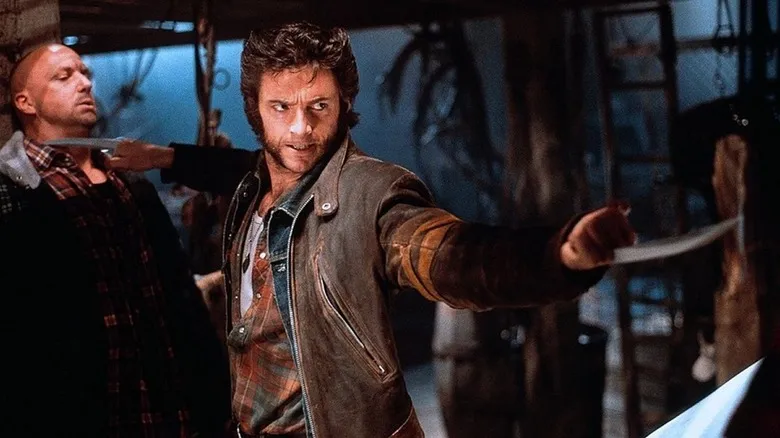
Bryan Singer's first two "X-Men" movies were somewhat trailblazers in the early aughts as far as super hero movie adaptations went. They felt different from the start — say, to Sam Raimi's "Spider-Man" or Mark Steven Johnson's horrendous live-action "Daredevil" — and that inherent quality remained intact to this day. The ensemble cast (including Hugh Jackman, Patrick Stewart, Ian McKellen, Famke Janssen, Anna Paquin, and more) played a vital part in that, but it was the character-driven writing that lifted 2000's "X-Men" as an outstanding piece of work at the dawn of the superhero movie boom.
What many might not know, however, is that "Men in Black" screenwriter Ed Solomon played a key role in that before he decided to give up his credit in the film as a writer (the story and the script are officially credited to Singer, Tom DeSanto, and David Hayter). The main characters of "X-Men" were fully-fledged, flesh-and-blood human beings instead of typical superhero archetypes due to Solomon's approach to the source material.
As the writer-director explained in a ComingSoon.net interview, "But what am I proud of? I got fired initially because I chose to write a superhero movie where their physical powers were external manifestations of their internal issues, and that they were written as real human beings. I'm still to this day really proud that I was the first person to do that." As a result, "X-Men" (alongside its 2003 sequel "X2: X-Men United") became a huge influence within the subgenre on every Marvel and DC movie adaptation that came after Singer's impactful feature.
X-Men's mutants were vulnerable and empathetic people first, and only superheroes second

In retrospect, Solomon regrets giving up the writing credit he could've gotten for "X-Men" for various reasons — knowing that it was a "stupid" and "immature" decision — but the main one is that he's still proud of it. As he elaborated in the interview, "I was stupid. I am proud of it. I'm proud of having worked on it. I'd have more money, and I'd have that credit. But at the end of the day, would I be a happier person? No, because it forced me into a kind of self-analysis and retooling of my own inner experience of work that made me a healthier person and maybe a better person overall. If I were to do it all over again, I wouldn't take my name off it."
It's easy to understand his remorse since "X-Men" gave fans some of the best versions of its recurring characters in the franchise. Hugh Jackman's Wolverine was truly established here as a complex, brooding, and volatile man, the essence of Anna Paquin's Rogue was captured perfectly, and the frenemy bond between Xavier and Magneto was instantly captivating and palpably profound.
All the mutants here were genuine people who became outcasts rejected by society for their otherness. At the time, Singer (and the writers who worked on the story, including Solomon) understood that's what drove the film and made it so relatable. "X-Men" didn't follow tropes but rather recreated them. It's too bad that today's numerous soulless and formulaic superhero flicks rarely find a mind like Solomon's to freshen things up and introduce a different perspective. Perhaps the bigger problem is that the demand for a change of direction from audiences is increasingly getting smaller, too.